Presence and Shared Attention
Theatre always begins before the first line is spoken. Merely having bodies together in a space right away lends an effect that pre-recorded media notably cannot mirror. That attains a certain collective attention in a way that subtly shifts how meaning is constructed. Within this group focus, one does not require consensus or similar reactions. Rather, that focus allows for an awareness-where divergent reactions are recognized, if not spoken out loud.
Attention as a Physical Act
Watching live performance is not purely mental. Sitting still, adjusting posture, holding breath, or shifting weight are all physical responses to what unfolds. These small bodily adjustments reflect engagement and shape perception. Unlike watching a screen alone, the audience feels itself being present, aware of its own attention as something tangible and sustained over time.
The Awareness of Being Seen
In a theatre, audiences are not invisible. Performers sense the room, its energy, and its responsiveness. This awareness influences pacing, emphasis, and delivery. Even without direct interaction, the knowledge that one is seen watching changes how attention operates. The audience becomes part of the environment rather than an external observer.
Silence as Collective Action
Silence in a theatre is rarely empty. It can signal absorption, tension, discomfort, or respect. Shared silence has weight because it is held together. When an audience collectively resists breaking silence, it reinforces the intensity of the moment. This kind of silence cannot be replicated by pausing a recording; it only exists when many people choose to remain still together.
Interpretation in Real Time
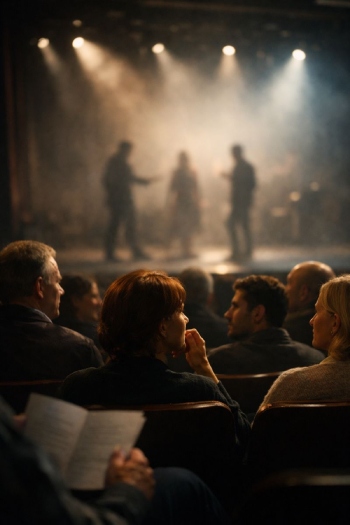
The main function of theatre is to provoke meaning. Yet, the actual sense of a theatre performance only comes about as it is in the process of being staged and experienced by spectators. Its audience subsidy foreground analysis, with one's own placement permitting negotiation even in the appearance of a public self and always-already-present others. This movement occurs in a space of uncertainty. It never waits, as the edited or recorded image does, for the play button to be pressed. In the ontology of interpretation, the interpretation must interlock with the appearance of the sentence.
Immediate Judgments and Revisions
Audience members constantly form and revise impressions. A line that initially feels confusing may gain clarity later. A character judged harshly early on may invite empathy by the end. Because the experience is continuous, interpretation remains flexible, shaped by unfolding context rather than isolated scenes.
Individual Meaning Within a Group
Even in a shared space, interpretation remains personal. Each viewer brings their own history, values, and sensitivities. What differs in theatre is the awareness that others are interpreting alongside you. Laughter, discomfort, or stillness from nearby seats can reinforce or challenge one’s own reading, prompting reflection rather than passive consumption.
Ambiguity Without Resolution
Live performance often leaves questions unanswered. This ambiguity can be unsettling, especially for audiences accustomed to clear narrative closure. Theatre asks viewers to sit with uncertainty, to accept partial understanding. The absence of definitive answers keeps interpretation active beyond the performance itself.
Resistance, Discomfort, and Refusal
Not all engagement is receptive. Audiences may resist what they see, feel challenged by it, or reject its premises entirely. These reactions are not failures of communication but part of the participatory nature of live performance.
Discomfort signals that something is at stake. Theatre can surface tensions that recorded media often smooths over through editing and distance.
Emotional Resistance
Some performances provoke discomfort by design. They may confront painful histories, ethical dilemmas, or social contradictions. Audience members may respond by withdrawing emotionally, questioning intent, or rejecting the framing. This resistance is itself a form of engagement, reflecting the work’s capacity to unsettle rather than entertain.
Social Pressure and Private Reaction
Being part of an audience can intensify internal conflict. A viewer may feel discomfort while others appear amused or engaged. This contrast can create self-awareness and prompt deeper questioning. Unlike solitary viewing, theatre exposes the friction between private response and public atmosphere.
Leaving the Room
Occasionally, resistance becomes physical. Walking out is a visible refusal that affects the room. While often framed negatively, departure is also a communicative act. It signals a boundary and becomes part of the performance’s impact, altering the experience for those who remain.
Time, Duration, and Commitment
Theater demands a continuity of time. When people sit down, they commit to sharing a period of time that cannot be interrupted or accelerated. This arrangement changes how attention operates when compared to digital media. The duration is the occasion of the emergence of reflection, discomfort, and change.
The Discipline of Staying
Remaining present through slower or challenging sections requires effort. This effort can deepen engagement by preventing easy escape. The commitment to stay allows moments to accumulate meaning rather than being reduced to highlights or clips.
Rhythm and Endurance
Live performance has rhythms that audiences learn to follow. Quiet passages, repetition, and extended stillness test patience but also recalibrate perception. Over time, attention adapts, becoming more sensitive to subtle shifts that might be overlooked in shorter formats.
The Weight of the Ending
Because theatre ends definitively, its conclusion carries particular weight. Applause, silence, or hesitation mark the transition back to ordinary time. The ending does not fade out gradually; it arrives and leaves the audience to process what remains.
Audience Behavior and Collective Norms
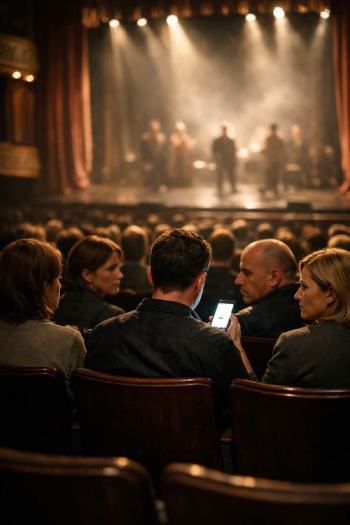
Theatre operates with unspoken rules that dictate the audience's behavior, which shape lines of participation right down to its apparent absence.
Understanding this shared expectation makes it clear why a performance could feel different before differing audiences.
This social contract, on which total attention is stipulated, is put into effect whenever performances are staged.
Here are the basic rules:
- Sit and pay attention at all times
- Refrain from talking, cell phone use
- Respond alone, with a comment, or with laughter, silence or applause
- Tolerate moments where the plot is lost without asking for an explanation
Learning How to Watch
Audience behavior is learned over time. Newcomers may feel uncertain about when to respond or remain silent. These norms are rarely explained, yet they shape comfort and access. Recognizing that watching theatre is a learned practice helps demystify the experience.
Variations Across Cultures and Contexts
Audience norms differ by region, genre, and setting. Some traditions encourage vocal response, while others emphasize restraint. These differences affect how participation is expressed and perceived. What feels respectful in one context may feel distant or disengaged in another.
Breaking the Contract
When norms are broken, intentionally or not, attention shifts. A ringing phone or loud comment can disrupt shared focus. At the same time, deliberate disruptions within experimental theatre may challenge these norms, inviting audiences to reconsider their role.
The Difference From Recorded Media
Recorded performances offer access and preservation, but they alter the conditions of attention. The absence of shared presence changes how audiences relate to what they see.
Live theatre resists fragmentation. It demands presence rather than multitasking.
Irreversibility and Risk
Live theatre unfolds without a safety net. Lines can be missed, timing can shift, and unexpected events can occur in full view of the audience. This vulnerability generates a heightened sense of alertness. Viewers understand that each performance is singular, shaped by that specific moment and room. The knowledge that nothing can be corrected or replayed increases attention. Risk sharpens focus, drawing audiences into a state of shared anticipation and responsibility.
Unmediated Experience
Theatre offers an encounter without technological filters. Bodies share the same air, light, and acoustics. Audiences register more than scripted dialogue: breathing, movement, hesitation, and reactions from nearby seats. These peripheral sensations create a layered awareness that screens typically exclude. Without framing or editing, perception remains open and continuous. The experience becomes spatial and relational, shaped as much by presence and proximity as by the action onstage.
Memory Over Replay
Because live performance cannot be revisited in exact form, audiences rely on memory to carry it forward. Recollection is selective and personal, shaped by emotion, emphasis, and later reflection. Conversations after the performance extend its life, allowing meanings to shift and deepen. Without recordings to fix interpretation, memory remains flexible. Theatre persists through what is remembered, misremembered, and shared rather than through permanent documentation.
Why the Room Matters
Theatre does not exist solely onstage. It exists in the space between performers and audience, shaped by attention, resistance, and shared presence. The room is not a neutral container but an active participant in meaning-making.
By entering the theatre, audiences accept a role that goes beyond watching. They contribute through attention, restraint, interpretation, and response.
Participation Without Performance
Audience members do not need to speak, move, or be acknowledged to participate meaningfully. Simply being present shapes the event. Attention, patience, and willingness to remain with the work help sustain the fragile conditions of live performance. Performers respond, consciously or not, to the quality of that presence. In this way, participation occurs through restraint rather than action. The audience contributes by holding space, allowing moments to unfold without interruption or demand for immediate payoff.
Attention as Responsibility
Giving attention in a theatre is not a neutral act. It involves choosing to stay engaged, even when material becomes difficult, unfamiliar, or uncomfortable. This attention recognizes the labor and risk involved in performing live before others. It also respects fellow audience members who share the experience. Theatre does not promise clarity or resolution in return. Instead, it offers a moment of shared presence shaped by mutual effort and collective focus.
What Lingers After Leaving
What audiences carry with them after a performance extends beyond plot or imagery. It includes the memory of sitting with others, responding quietly and privately to the same unfolding event. These memories are shaped by atmosphere, silence, and shared tension as much as by dialogue. Over time, specific details may fade, but the feeling of collective attention often remains. This residue of shared experience is what sets live theatre apart from recorded media.
The Quiet Power of Being There
The audience is not a backdrop. They are a living part of the very meaning of theatre. Coming together without disruptions, they have, in essence, established alongside the artist(s) an attention that refuses to be hyphenated. Within that stillness, theatre claims its own impact, not because it requires attention, but because attention is then altogether inescapable.