The Pre-Rehearsal Landscape
The periods before rehearsals are mostly unknown to the audience and hold much of the inchoate material that is going into the character of the work. The phase is not a phase of shine and presentation but of hunting for the material, classification, and checking of ideas that might never show on the performing space but shape everything about what does. This is where the playwright steps back from lines and instead fixes meanings into which the play can be staged.
Unlike prose, the theatre is not about rendering a world in words. It provides something: a condition for something to happen in the midst between individuals, in a shared space. This difference informs every elementary choice: of whether this material can deploy an actual performance, of which queries to engage.
Experience as Raw Material
Lived experience often enters a play in indirect ways. A conversation overheard years earlier, a familiar social dynamic, or a recurring personal conflict can all become starting points. These experiences are rarely transferred intact. They are broken down, abstracted, and reshaped to serve the needs of the stage.
What matters is not factual accuracy but emotional or structural truth. A playwright may draw from personal history without reproducing it, using it instead to inform tone, rhythm, or the stakes of a situation. Experience becomes useful when it helps generate tension, choice, or contradiction that actors can embody.
Observation and Social Awareness
Beyond personal experience, playwrights often rely on close observation of how people speak, avoid speaking, assert power, or lose it. These patterns are not invented in isolation. They emerge from paying attention to everyday interactions and noticing what goes unsaid as much as what is expressed openly.
This observational work helps ground a play in recognizable behavior. Even highly stylized or abstract theatre often depends on these observed dynamics to remain legible. Before rehearsals, such observations are gathered without judgment, forming a reference point for later choices.
Memory as a Shaping Force
Memory plays a distinct role in early theatrical development. Unlike direct experience, memory is already filtered, partial, and shaped by time. This distortion can be productive. What is remembered is often what carried emotional weight, and that weight can translate effectively to the stage.
Memories may influence a play’s structure rather than its content. A fragmented recollection might suggest a non-linear form. A recurring memory might inspire repetition or echo. In this way, memory guides not just what the play is about, but how it unfolds.
Research Beyond Information
Research in theatre is not limited to gathering facts. While historical or technical accuracy can matter, research often serves a broader purpose: expanding the playwright’s imaginative range. It introduces unfamiliar perspectives, constraints, and contexts that challenge assumptions formed through personal experience alone.
This research phase is exploratory rather than conclusive. It opens possibilities instead of closing them. Facts are less important than implications, tensions, and questions that can be activated in performance.
Context and Constraint
When a play engages with a specific time, place, or system, research helps define the boundaries within which characters operate. Social norms, legal structures, or material conditions can all function as constraints that shape dramatic action.
These constraints are not background decoration. They determine what choices are possible and what risks those choices carry. Understanding them before rehearsals allows the playwright to embed pressure points into the material, giving actors something real to push against later.
Language and Register
Research often informs how characters speak, even when dialogue is not strictly realistic. Exposure to particular speech patterns, professional jargon, or cultural registers can influence rhythm and vocabulary without being reproduced verbatim.
This attention to language supports credibility on stage. Audiences may not consciously identify why a line feels grounded, but they sense when speech aligns with the world the play suggests. Early research helps establish that alignment before any lines are finalized.
Ethical Awareness
Research also raises ethical considerations. Engaging with histories of violence, marginalization, or trauma requires care. Before rehearsals, this awareness influences what material is approached directly, what is handled obliquely, and what may be better left implied.
These decisions are not about avoiding difficulty, but about choosing forms that respect both subjects and audiences. Ethical awareness at this stage shapes the play’s relationship to its material long before actors encounter it.
Imagination as Structural Work
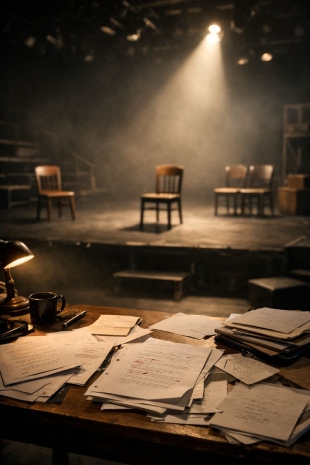
In theatre, imagination has often been misconceived and equated with invention instead. In practice, imagination is more akin to arrangement. It is the bringing together of experiences, research, and vivid flashes in such an assembly that they can be enacted-live.
This kind of imaginatively created structure is about relatedness: scenes, timing, nothing and keeping quite as meaningfully significant as speech does. These choices are made prior to rehearsals, as they will determine the conversation that will happen during rehearsals.
From Idea to Situation
Early ideas are rarely dramatic on their own. Imagination transforms ideas into situations by introducing conflict, urgency, or imbalance. A theme becomes playable when it is expressed through characters who want incompatible things under specific conditions.
This shift from concept to situation is crucial. Theatre depends on action. Before rehearsals, the playwright tests whether imagined scenarios can generate action repeatedly, not just once.
Spatial Thinking
Because theatre unfolds in space, imagination must account for physical relationships. Even before a venue is chosen, playwrights often think spatially: who is near whom, who is isolated, who controls the center of the room.
These spatial ideas influence dialogue and pacing. They also leave room for directors and designers to interpret, rather than dictating fixed solutions. Early spatial thinking sets parameters without closing off possibility.
Time and Compression
Imagination also governs how time is treated. Plays compress, stretch, or loop time in ways that differ from lived experience. Before rehearsals, choices about duration and sequencing help determine the audience’s experience.
These choices are rarely final at this stage, but an initial sense of temporal logic helps orient later development. It clarifies whether the play builds gradually, unfolds episodically, or resists linear progression altogether.
Writing for Stage, Not Page
One of the defining features of pre-rehearsal work is the awareness that the text is not the final product. A play script is a tool, not a container. It exists to be used by actors, directors, and designers in a shared process.
This understanding shapes how material is drafted. The writing leaves space for interpretation, adjustment, and discovery. It anticipates change rather than resisting it.
Dialogue as Action
In theatre, dialogue is not primarily descriptive. It is a form of action. Characters speak to affect one another, to conceal, to provoke, or to test boundaries. Before rehearsals, dialogue is evaluated for what it does rather than how it reads.
This focus often leads to spare language. What matters is clarity of intention and responsiveness, not literary flourish. Lines must be playable, capable of being inhabited by different actors without losing force.
Silence and Absence
What is omitted can be as important as what is written. Pauses, interruptions, and unresolved moments create space for performers to contribute meaning. Early drafts often mark these absences intentionally.
By planning for silence before rehearsals, playwrights acknowledge the collaborative nature of theatre. They trust that meaning will emerge through timing, gesture, and presence, not text alone.
Flexibility and Revision
Pre-rehearsal writing remains provisional. Scenes may be rearranged, condensed, or removed once voices and bodies enter the room. Anticipating this fluidity helps playwrights avoid overinvestment in fixed solutions.
This flexibility is not a lack of discipline. It is a recognition that theatre is completed in practice. Early writing aims to support that completion rather than preempt it.
Collaboration Before Collaboration
Even as the playwright works alone, the pre-rehearsal stage is, in a sense, an acknowledgment of future collaborators. A playwright waits for the imagined responses from actors, director, and audience, possibly influencing decisions without any physical presence of anyone being there. This element of anticipation eventually shapes the 'feel' of the play - depends on the tone, scale and readiness with which it will be embraced. It puts the work into a category where it is always an invitation, a beginning, rather than a closure, clear statement.
Imagined Performers
Playwrights often write with performers in mind, whether specific individuals or general types. This does not limit casting but helps calibrate physicality, vocal demands, and emotional range.
Considering performers early encourages practical thinking. It asks whether the material offers agency and challenge, rather than positioning actors as vehicles for ideas alone.
Audience Presence
The audience is another silent collaborator in pre-rehearsal work. Decisions about ambiguity, humor, or discomfort are made with an awareness of how a live audience might respond collectively.
This does not mean predicting reactions precisely. It means acknowledging that meaning in theatre is co-created in real time. Early development prepares for that exchange.
Room for Interpretation
Finally, pre-rehearsal work aims to leave interpretive space. Directors and designers bring their own frameworks, and strong material can support multiple readings.
By resisting over-definition early on, playwrights allow the work to adapt to different contexts without losing coherence. This openness is a strength, not an omission.
Material Before Method
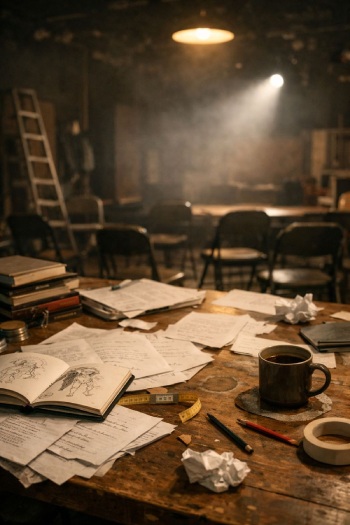
Before rehearsals impose schedules, budgets, and production constraints, the work exists as material in motion. It is shaped by attention, curiosity, and restraint rather than by technique alone.
This phase privileges questions over answers. It values potential over certainty. The goal is not to solve the play, but to prepare it for encounter.
Letting Questions Lead
Strong plays often begin with unresolved questions. Pre-rehearsal development allows these questions to remain open long enough to generate complexity.
Rather than forcing resolution, the playwright tests how long uncertainty can be sustained productively. This patience often leads to richer outcomes once rehearsals begin.
Avoiding Premature Closure
There is a temptation to finalize too early, to lock down structure or meaning before the work has been tested. Pre-rehearsal awareness resists this impulse.
By accepting incompleteness, playwrights keep the work responsive. They allow collaboration to function as intended, completing what was only outlined.
Trusting the Process
Ultimately, this phase requires trust: in observation, in research, in imagination, and in future collaborators. The playwright prepares conditions rather than outcomes.
This trust does not guarantee success, but it creates the possibility for genuine discovery when rehearsal begins.
Before the Lights Come Up
The material gathered there comprises experience, knowledge, memory, and phantasy, molded into the theater encounter that has been preplanned and devised before. It emphasizes context, structure, and openness; seldom do techniques accompany the embodiment of text. Only when rehearsals begin is the production shaped. Development of those initial things must be made cheaply possible for performance.